Two glass vials of blood, packed in melting ice inside a cheap blue thermos flask, arrived at the Institute of Tropical Medicine in Antwerp on 29 September 1976. One of them had broken on the way. The flask had travelled in the hand luggage of a passenger on a scheduled Sabena flight from Kinshasa, which is how biological samples moved around the world in those days.
The blood belonged to a Flemish nun who was dying in a Kinshasa hospital of a disease nobody could name. Within a few weeks it would have a name, taken from a river most of the scientists involved had never seen, and the small town where she had worked would become the most studied place in the history of epidemiology. Nigeria confirmed its first Ebola case in about a decade this week, a traveller from Uganda now isolated in Abuja, so it seems a reasonable moment to go back to where the whole thing started.
A headmaster with a fever
Yambuku is a mission settlement in the Équateur region of what was then Zaire and is now the Democratic Republic of the Congo, deep in the forest north of the Congo River. In 1976 it had a Catholic mission run by Flemish priests and nuns, a school, and a 120-bed hospital that served a wide area and saw several hundred outpatients a day. The hospital had a handful of glass syringes, which the nuns boiled in the morning and then reused through the day. There was no doctor.
On 26 August 1976 the headmaster of the mission school, a 44-year-old man named Mabalo Lokela, came to the clinic with a fever. He had just returned from a trip north toward the border with the Central African Republic. The nuns assumed malaria and gave him a chloroquine injection. The fever went away and came back worse. By early September he was bleeding from the nose and gums, and on 8 September he died.
By then the people who had been injected at the clinic in the days after him were falling ill too, and so were the people who had nursed him, and the people who had washed his body for the funeral according to local custom. When the investigators reconstructed the first few weeks, nearly every early case had either received an injection at the hospital or had close contact with someone who had. Of the hospital's seventeen staff, thirteen caught the disease and eleven died. The hospital closed on 30 September because there was almost nobody left to run it.
Antwerp, then Atlanta
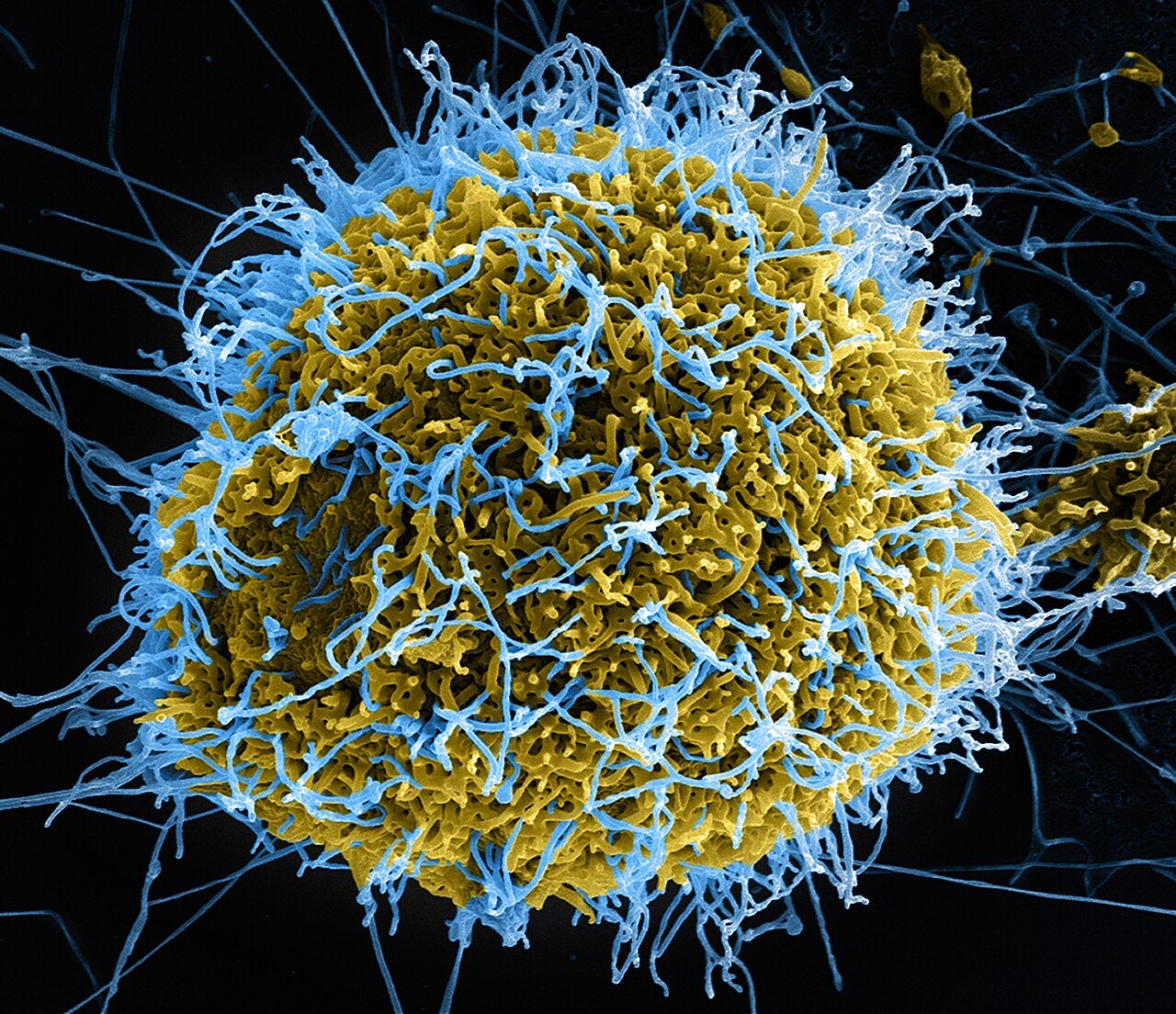
In Antwerp the flask was opened by a team that included a 27-year-old microbiologist named Peter Piot, his colleague Guido van der Groen and their chief, Stefaan Pattyn. They were working, by their own later admission, with far less protection than the material deserved. Under the electron microscope the virus showed up as long filaments, coiled and hooked at one end, something between a worm and a shepherd's crook. The only known virus that looked anything like it was Marburg, which had killed laboratory workers in Germany in 1967 after arriving in a shipment of monkeys.
The Belgians sent material on to the Centers for Disease Control in Atlanta, which had the world's only high-containment laboratory equipped for this sort of thing. There, in mid-October, Frederick Murphy took the electron micrograph that still illustrates almost every article about the disease, and Patricia Webb and Karl Johnson established that the virus was distinct from Marburg, and therefore new.
The name came later, at a meeting in Kinshasa. The scientists did not want to call it Yambuku virus, because Marburg had never shaken off its association with a town that had done nothing worse than receive some sick monkeys. Johnson proposed naming it after a river instead. Someone found the nearest one on a small wall map, the Ebola, which runs some sixty miles from the mission. Piot later wrote that the map was not very accurate and the Ebola was not in fact the closest river. The name stuck anyway.
Shutting down a province
President Mobutu's government placed the Bumba Zone, an area roughly the size of a small European country, under military quarantine, with roads blocked and flights stopped. An international commission under Johnson flew in, and Piot and the American epidemiologist Joel Breman went up to Yambuku by helicopter and then by road. They found villages that had already quarantined themselves, with branches laid across the paths and the sick left in huts at the edge of the settlement. The traditional response turned out to be the right one.
The final tally for Yambuku and the surrounding villages was 318 cases and 280 deaths, a death rate of 88 percent. The outbreak had already burned itself out by the time the commission arrived in force. The hospital had closed, the funerals had stopped, and the virus had run out of people.
What nobody appreciated for several weeks was that a second outbreak had been going on at the same time, 500 miles to the northeast, around the cotton factory town of Nzara in southern Sudan. That one had started in June, killed 151 of 284 patients, and was caused by a different species of the same virus. Historians of the disease still argue about whether the two were connected. The current view is that they were not, which is unsettling in its own way.
From five syringes to nine thousand cases
For almost two decades after 1976, Ebola was a disease that flared in remote places and went out. The 2014 West African epidemic ended that pattern, with more than 28,000 cases across Guinea, Liberia and Sierra Leone. Nigeria's part in it is worth remembering this week. A Liberian-American official named Patrick Sawyer collapsed on arrival at Lagos airport in July 2014 and was taken to a private hospital, where the senior doctor, Ameyo Adadevoh, refused to discharge him despite considerable pressure. She contracted the disease and died in August. Nigeria finished with twenty cases and eight deaths, and was declared free of the virus that October. In a city the size of Lagos, that counted as a triumph.
The case confirmed in Abuja on 21 October is linked to an outbreak in the eastern Congo that was declared in May and has since grown past nine thousand cases and four thousand deaths, the second largest on record. It is caused by the Bundibugyo species, which was only identified in 2007, and which the licensed Ebola vaccine does not cover. Kenya has reported cases this month as well. Health officials in Abuja say the patient is isolated and that her contacts, most of them hospital staff, are being traced.
The nuns of Yambuku boiled their five syringes every morning because they had no others. Fifty years and several billion dollars of research later, the thing that stops an Ebola outbreak is still mostly the thing that stopped the first one: finding the sick fast, keeping them apart from everyone else, and burying the dead carefully. I find that less reassuring than it is meant to sound.
Enjoyed this story?Get a new one every day on social.