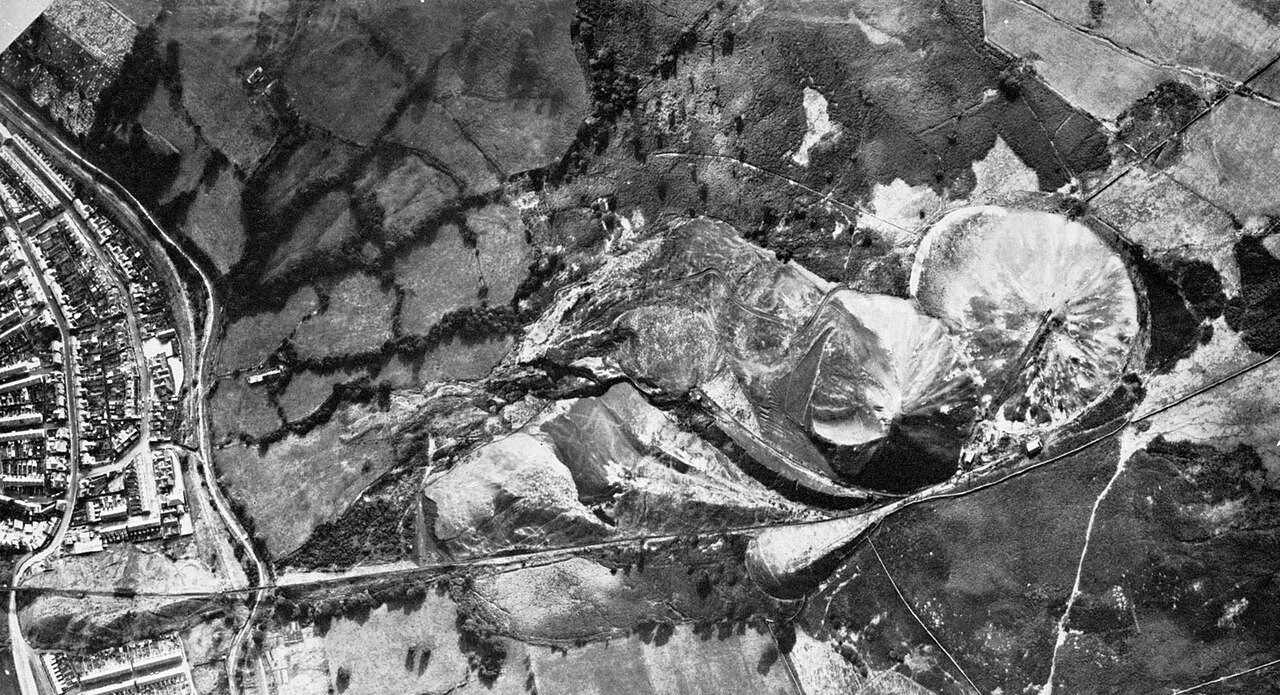
Photo: Unknown UK government photographer, Aberfan Tribunal report plate (1967), public domain, via Wikimedia Commons
At about a quarter past nine on Friday 21 October 1966, the children of Pantglas Junior School in Aberfan had just come back from assembly. It was the last day before half term. The hillside above the village was stacked with waste from the Merthyr Vale Colliery, seven tips of shale and slurry dumped there over half a century, and tip number seven, started in 1958, sat on top of a spring. It had been raining for days.
The gang who worked the tip had gone up early and found that its crest had sunk about ten feet overnight. They could not ring down to warn anyone, because the telephone cable had been stolen (not for the first time), and while they were still deciding what to do about it the tip started to slide.
The slide and the first hours
Something like 150,000 cubic yards of saturated waste came down the hill fast enough that people heard it before they saw it. It crossed the old canal and the railway embankment, destroyed a farm cottage and a row of houses on Moy Road, and went through the back wall of the school. In the classrooms that faced the hill there was nowhere to go.
The first people digging were miners, up from the pit or off shift, with shovels and bare hands, while women passed rubble back along human chains. Soldiers and police followed later in the morning, and so did enough sightseers to jam the roads. Children were pulled out alive in the first hour or so. Nobody was found alive after eleven o'clock.
The dead numbered 144, and 116 of them were children, most between seven and ten. Five teachers died too. The Bethania chapel became a mortuary, and parents walked along the rows.
"Bungling ineptitude"
Lord Robens, chairman of the National Coal Board, did not come that day. He went ahead with his installation as Chancellor of the University of Surrey and reached Aberfan the following evening, and when he spoke to the cameras he said nobody could have known there was a spring under the tip. Ordnance Survey maps of the hillside had shown springs there for decades.
The tribunal of inquiry, chaired by the Welsh judge Sir Edmund Davies (born a few miles down the valley in Mountain Ash), sat for 76 days and heard 136 witnesses. Its 1967 report called the disaster "a terrifying tale of bungling ineptitude by many men charged with tasks for which they were totally unfitted, of failure to heed clear warnings, and of total lack of direction from above." I have read a great many official reports, and very few are that blunt.
The warnings had been plain. Tips on that hillside had slipped in 1944 and in 1963, and the local council had written to the Board about the danger to the school. The Board had no real tipping policy and nobody whose job it was to check a tip's stability. Its lawyers still spent weeks arguing the slide was an act of unforeseeable geology.
Nine Coal Board employees were named in the report. None was prosecuted. None of them lost his job either. Robens offered to resign; the minister, Richard Marsh, said no. Parliament passed the Mines and Quarries (Tips) Act in 1969, which made tip owners legally responsible for their safety for the first time.
Who paid to move the tips
Close to 90,000 donations arrived from around the world, and the Aberfan Disaster Fund reached about £1.75 million. The Charity Commission then wondered aloud whether paying bereaved parents was a proper charitable purpose, and at one stage suggested checking whether parents had been "close" to the children they lost before paying them. They eventually received £5,000 a family.
The remaining tips still loomed over the village, and villagers wanted them gone badly enough to tip bags of slurry onto the floor of the Welsh Office in Cardiff. The government agreed to remove them on condition that the disaster fund put in £150,000. The trustees paid. Ron Davies, as Welsh Secretary, returned the money in 1997, without interest. Ten years later the Welsh Assembly Government gave £1.5 million to the memorial charity and £500,000 to an education fund for the village, which was about as close to an apology as anyone came.
The Queen's eight days
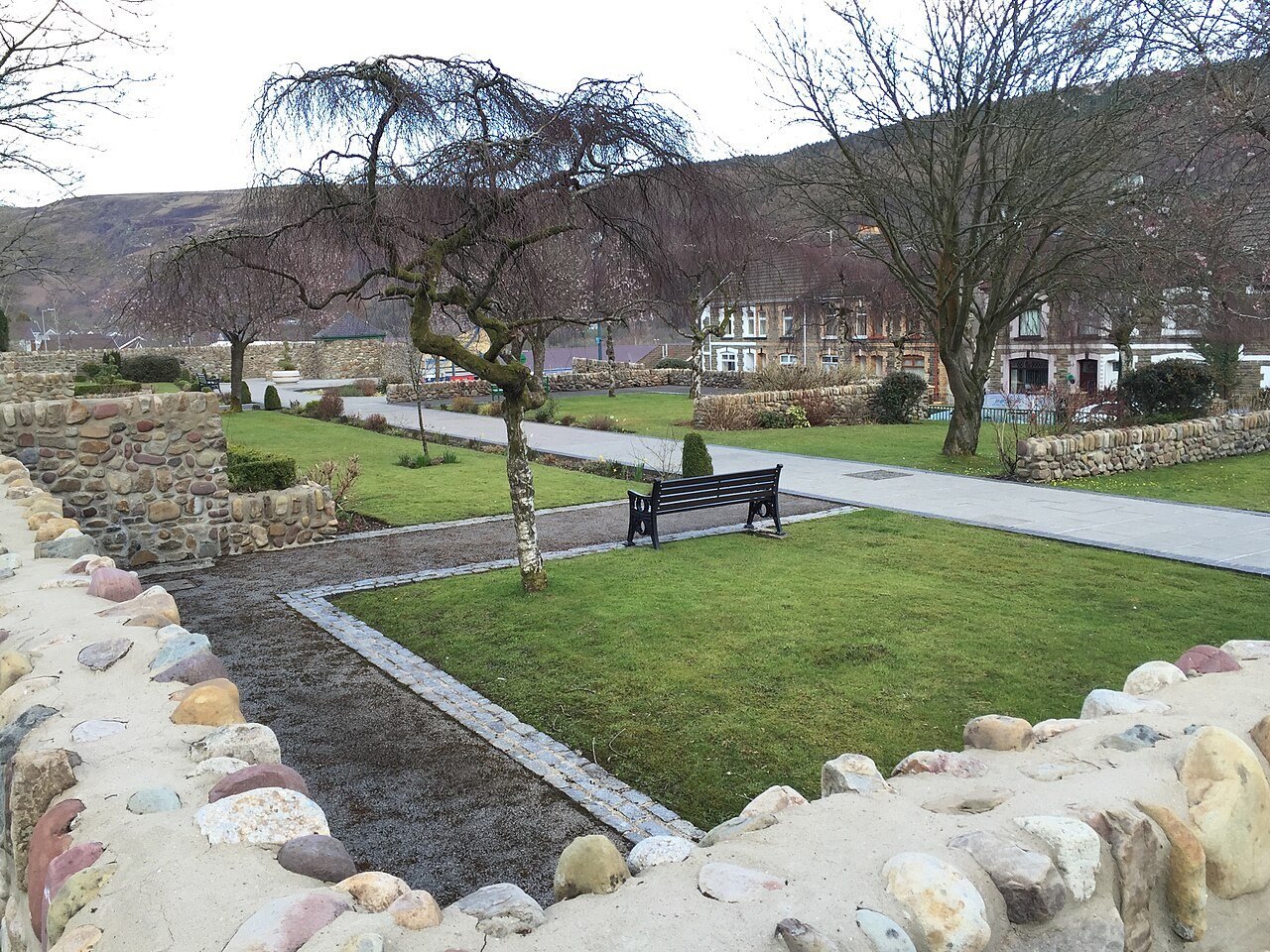
The memorial garden on the site of Pantglas Junior School, Aberfan. Photo: Alan Hughes, CC BY-SA 2.0, via Wikimedia Commons
Harold Wilson, Prince Philip and Lord Snowdon all came within a day or so. Elizabeth II came on 29 October, eight days after the slide, and was handed a posy with a card reading "From the remaining children of Aberfan." Courtiers later said she had held back so as not to get in the way of the rescue, and some who worked for her said it was the thing she regretted most in her reign. That rests on memories rather than paper, but I see no reason to doubt it. She went back to the village several times, the last in 2012.
About half the school's pupils survived. In 1966 nobody offered them counselling, and the common view was that children got over things if you did not talk about them. A study published in 2003 followed survivors more than thirty years later and found that roughly half had at some point met the criteria for post traumatic stress disorder.
The school site is a memorial garden now, its paths laid along the lines of the old classrooms. In the cemetery the children are buried in two long rows under white arches you can see from the A470, though most of the people driving past have no idea what they are.
Sixty years later, the tips are still there
The pits in South Wales closed long ago, but the waste they piled up is mostly still on the hillsides. The Welsh Government counts more than 2,500 disused coal tips in Wales, and after a tip slid into the valley at Tylorstown in the Rhondda during Storm Dennis in February 2020, it finally surveyed them properly. Around 350 went into the two highest risk categories, the ones that could threaten homes or people if they failed.
In 2025 the Senedd passed the Disused Mine and Quarry Tips (Wales) Act, which received Royal Assent on 11 September and creates a Disused Tips Authority for Wales to register, inspect and manage them. The authority is due to open in April 2027, a little over sixty years after the tribunal first said someone ought to be watching these heaps.
The village holds its own commemorations today. Some of the children who were sitting in classrooms on the far side of the school, away from the hill, still live in the valley. They are about seventy now.
Enjoyed this story?Get a new one every day on social.