Why We Still Change the Clocks: A Wartime Coal Measure That Never Went Away
This Sunday, 25 October, hundreds of millions of people across Europe will wake up to find their phones have quietly given them an extra hour. A week later, on 1 November, the United States and Canada will do the same. Almost nobody can explain why, and a good many will complain about it over breakfast.
The habit feels old, something handed down from farmers or the railways. It is younger than that. The first country to move its clocks forward for the summer did so on 30 April 1916, in the middle of the First World War, to burn less coal. (The farmers, as it turned out, hated it.)
An idea from a builder and an insect collector
Two people are usually credited with the idea. In 1895 George Hudson, a New Zealand postal worker who collected insects in his spare time and wanted more daylight after work, proposed a two-hour summer shift to the Wellington Philosophical Society. The society heard him out and did nothing.
Ten years later William Willett, a wealthy English builder, had the same thought during an early-morning ride and spent the rest of his life campaigning for it. His 1907 pamphlet, "The Waste of Daylight", argued that Britons were sleeping through the best light of summer mornings. A bill went to Parliament in 1908 and came back year after year, failing each time. Farmers objected, so did astronomers, and a fair number of members simply thought legislating the time of day was ridiculous. Willett died in 1915 with nothing to show for it.
Germany moves first
By 1916 Germany was blockaded and short of coal. Every hour of evening daylight was an hour that homes and factories did not need to light with gas or electricity, almost all of it produced from coal. On 30 April 1916 the German Empire and its ally Austria-Hungary advanced their clocks by one hour.
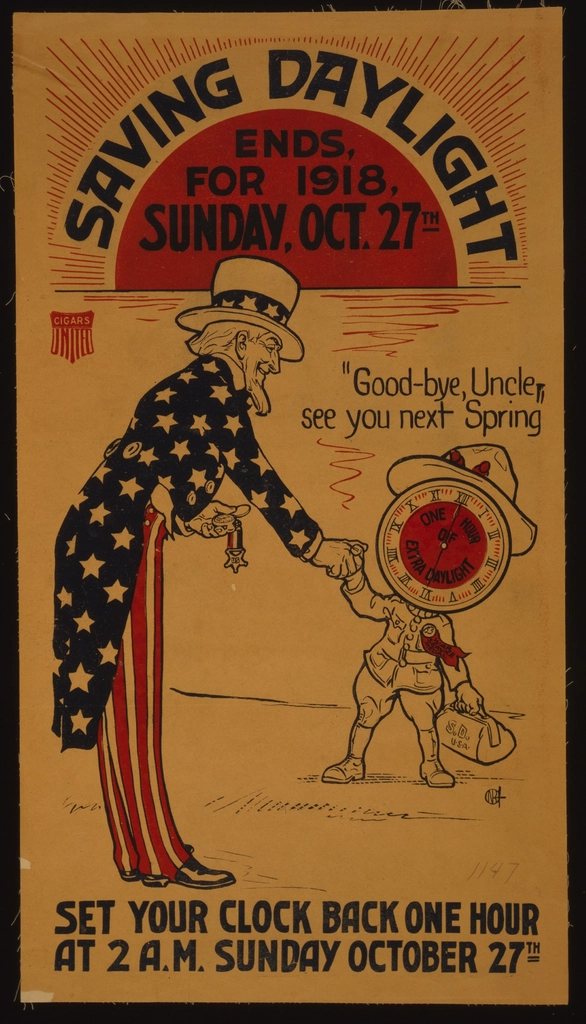
The reaction was immediate. Britain, which had argued about the idea for eight years, passed the Summer Time Act within three weeks and moved its clocks on 21 May 1916. France, the Netherlands, Italy, Denmark, Norway and Sweden followed that same summer. Russia adopted it in 1917, and the United States in March 1918, with posters like the one above instructing the public to set their clocks back at 2 a.m. when the season ended.
An idea Parliament had laughed at for eight years was law across most of Europe within four months.
Peace, repeal, and the long argument
As soon as the war ended, most countries dropped it. The United States repealed national daylight saving in 1919 over President Wilson's veto, after a revolt led by farmers who, far from benefiting, found the shift put them out of step with markets, trains and hired labour. Cities such as New York kept their own version, which created decades of confusion in which a traveller could pass through several different local times in a single day.
The Second World War brought it back everywhere. Britain went further and adopted "double summer time", two hours ahead, to squeeze more out of the working day. The United States ran "War Time" year-round from 1942 to 1945.
After 1945 the pattern repeated: patchy, local, inconsistent. The US Uniform Time Act of 1966 finally standardised the dates nationally while letting states opt out, which Arizona and Hawaii did. The 1973 oil crisis prompted a brief American experiment with year-round daylight saving that was abandoned within a year after complaints about dark winter mornings and children walking to school before dawn.
Europe synchronises, then tries to stop
Western Europe re-adopted summer time piecemeal during the oil shocks of the 1970s, and the European Community harmonised the dates in 1980 so that cross-border trains and broadcasts would line up. Since 1996 the whole European Union has changed its clocks together on the last Sundays of March and October.
Once everyone changed together, the effects became easy to measure, and the measurements were not flattering. Studies for the European Commission and national governments found the energy savings to be small, sometimes negligible, since modern lighting is efficient and heating and air conditioning now dominate consumption. Medical researchers meanwhile reported a short-term rise in heart attacks, road accidents and workplace injuries in the days after the spring change, when the population loses an hour of sleep.
In 2018 the Commission ran a public consultation that drew 4.6 million responses, 84 percent of them in favour of ending the clock change. The European Parliament voted in March 2019 to abolish it from 2021. Then the plan stalled. Member states could not agree on whether to settle on permanent summer time or permanent winter time, and nobody wanted a patchwork of neighbouring countries an hour apart. The directive has sat in the Council ever since. Europe keeps changing its clocks because it cannot agree on how to stop.
The world mostly gave up
Seen globally, daylight saving time is now the exception. Most of Asia and Africa never adopted it or dropped it long ago. Russia abandoned the change in 2011, tried permanent summer time, found the winter mornings unbearable, and switched to permanent standard time in 2014. Turkey stopped in 2016, Brazil in 2019, Mexico in 2022. Fewer than 70 countries still observe it, concentrated in Europe, North America and parts of the Middle East and Oceania.
In the United States the Senate passed the Sunshine Protection Act in 2022 to make daylight time permanent, but the House never took it up, and the debate has repeated in every Congress since. Dozens of states have passed laws saying they will stop changing clocks the moment federal law allows. It does not yet.
Still running on 1916 time
Daylight saving time outlived the reason for it. The coal shortage ended with the war; the clock change stayed, partly from habit and partly because nobody wants to be the one country an hour out of step with its neighbours. Getting rid of it needs a decision that every government would rather someone else took first.
So this Sunday the clocks go back again, as they did in Berlin and London in the autumn of 1916, when the whole thing was supposed to last one season. Willett campaigned for a decade and never saw it adopted. It has now been in force, on and off, for a hundred and ten years, and the argument he started is still going.