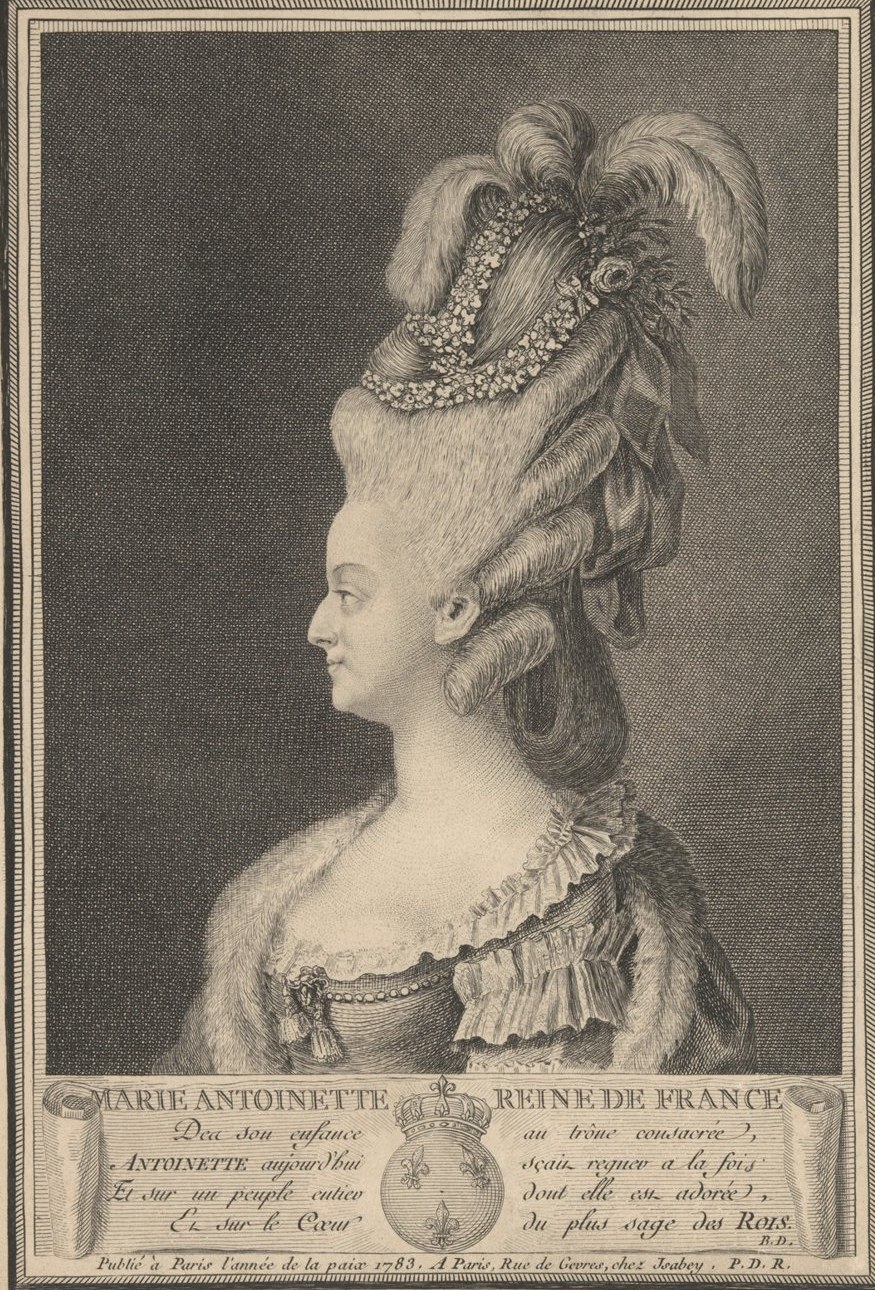
Engraving: Jean-Baptiste Isabey, Marie Antoinette, Queen of France (1783), The Metropolitan Museum of Art, CC0
Sofia Coppola's Marie Antoinette turned twenty this week, and a documentary about the making of it, shot by her mother Eleanor and finished after Eleanor's death in 2024, opens in cinemas today. The 2006 film was booed at Cannes, or at least whistled at. It also contains the only version of the cake line I have ever been able to stand: Kirsten Dunst reads the accusation in a pamphlet, laughs, and says she would never say such a thing.
She was right, and historians have been saying so for more than a century. The question worth asking is who did say it, if anyone, and why a bored Austrian teenager ended up carrying it to the guillotine and beyond.
A line from a book written in the 1760s
The earliest known appearance of the phrase is in Jean-Jacques Rousseau's Confessions, in the sixth book, which he wrote around 1765 to 1767 and which was published after his death. Describing a time in his youth when he wanted bread to go with some wine he had stolen, Rousseau recalls "the stopgap of a great princess, who was told that the peasants had no bread, and who replied: then let them eat brioche."
He does not name the princess. He gives no date. The anecdote is about his own embarrassment at going into a baker's shop, not about the French court. And the episode he is describing took place around 1740, when the princess who would become the most hated woman in France had not been born.
Marie Antoinette was born in Vienna on 2 November 1755. When Rousseau wrote the sentence she was ten or eleven, a child in the Habsburg nursery. She arrived in France in May 1770 at fourteen to marry the future Louis XVI, and the Confessions did not appear in print until 1782. So the line existed, in a manuscript, before she set foot in the country, and was attached in Rousseau's own words to someone who was already a "great princess" when he was a young man.
Brioche is not cake
The word matters too. Rousseau wrote brioche, which in the eighteenth century meant a bread enriched with butter and eggs, a luxury loaf rather than a dessert. "Cake" is an English translation that makes the line sound sillier than the French. There is a long-running claim that a Paris police regulation obliged bakers who ran out of cheap bread to sell their fine loaves at the cheap price, which would make the remark a bureaucratic instruction rather than a sneer. I have never seen a good primary source for that regulation and I would not put weight on it, but it does show how much effort people have spent trying to make the sentence make sense.
Bread was not a figure of speech in France then. Historians' estimates put a Parisian labourer's spending on bread at around half of his income in an ordinary year, and far more than that in the bad ones. The spring of 1775, the year after Louis XVI came to the throne, brought the Flour War, a wave of riots over grain prices across the Paris basin. Marie Antoinette, nineteen years old and just back from her husband's coronation at Reims, wrote to her mother that summer that seeing people who treated the royal couple so well despite their own misfortune made the couple more obliged than ever to work for their happiness. It is not the letter of someone recommending brioche.
Who else has been blamed
If not her, then who? Louis XVIII, her brother-in-law, wrote in a memoir published in 1823 that the remark was an old family story about Maria Theresa of Spain, the wife of Louis XIV, who was supposed to have asked why the hungry did not eat pastry crust. Other versions pin it on one of Louis XV's unmarried daughters. Antonia Fraser, in her 2001 biography, favours the Spanish queen. None of these has any better evidence behind it than Rousseau's unnamed princess. The line may simply have been a joke about royalty in general, the kind that gets told about whichever grandee is least popular that year.
That is how it reached Marie Antoinette. The revolutionary pamphlets of the 1780s and 1790s accused her of almost everything, and the bread crisis of 1789 made a bread joke the obvious one to throw. When the market women marched on Versailles in October 1789 and brought the royal family back to Paris, they called their prisoners the baker, the baker's wife and the baker's boy. The cake line fitted that story so well that it did not need to be true.
Fifty years late
What surprised me, when I went looking, is how late the attribution is in print. The first writer known to have connected the phrase to Marie Antoinette by name was the journalist Alphonse Karr, in his magazine Les Guêpes in 1843, half a century after her execution. And Karr brought it up to deny it: he said he had found the anecdote in a book of 1760 and that it had nothing to do with the late queen. Debunking it, in other words, is how it became famous. Every popular history since has repeated the denial and the line together, and readers remember the line.
The baguette, which did not exist in anything like its modern form in 1789, has been on UNESCO's intangible heritage list since 2022. Somebody, somewhere in the French court of the eighteenth century, may really have said the thing about brioche. We will probably never know who, and I suspect that is the only reason the story has lasted.
Enjoyed this story?Get a new one every day on social.