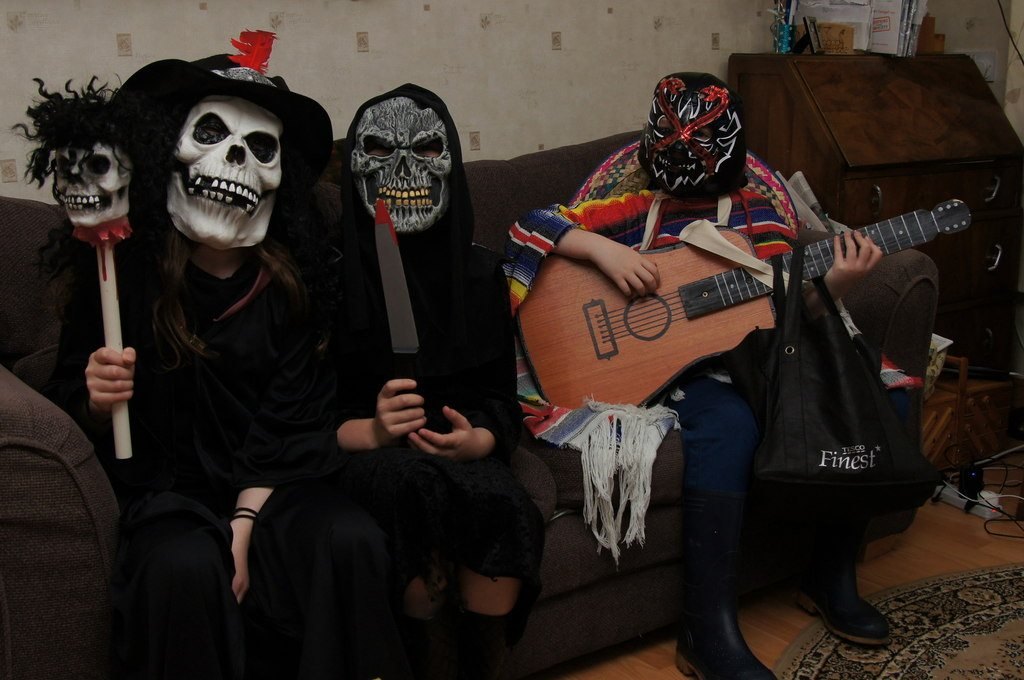
Photo: Mike Pennington, Halloween guisers or grölicks, Baltasound, CC BY-SA 2.0, via Wikimedia Commons
Ten days from now, a great many children will knock on a great many doors and say three words that sound as if they go back to the Druids, although they don't. The earliest printed "trick or treat" anyone has found is from a small-town news column in Alberta in November 1927, and for a long time after that most Americans would not have known what it meant.
The custom underneath the phrase is older and arrived in pieces, some English and more of it Scottish and Irish. The last piece was American and dates from the 1930s, when the treat was effectively a payment and the trick was what happened to your windows if you didn't make it.
Begging for the dead
In medieval England, the poor went door to door around All Souls' Day on 2 November asking for food, and in return promised to pray for the household's dead. The food was a soul cake, a small spiced bun, sometimes marked with a cross. The practice is called souling and it lasted, in parts of Cheshire, Shropshire and Staffordshire, into the twentieth century, long after anyone believed the prayers were doing much for the souls in question.
Shakespeare knew the custom well enough to joke about it. In The Two Gentlemen of Verona, a servant complains that his lovesick master has taken to speaking "puling, like a beggar at Hallowmas." That was in the 1590s, and the line only works if the audience had heard a beggar at Hallowmas themselves.
The guisers
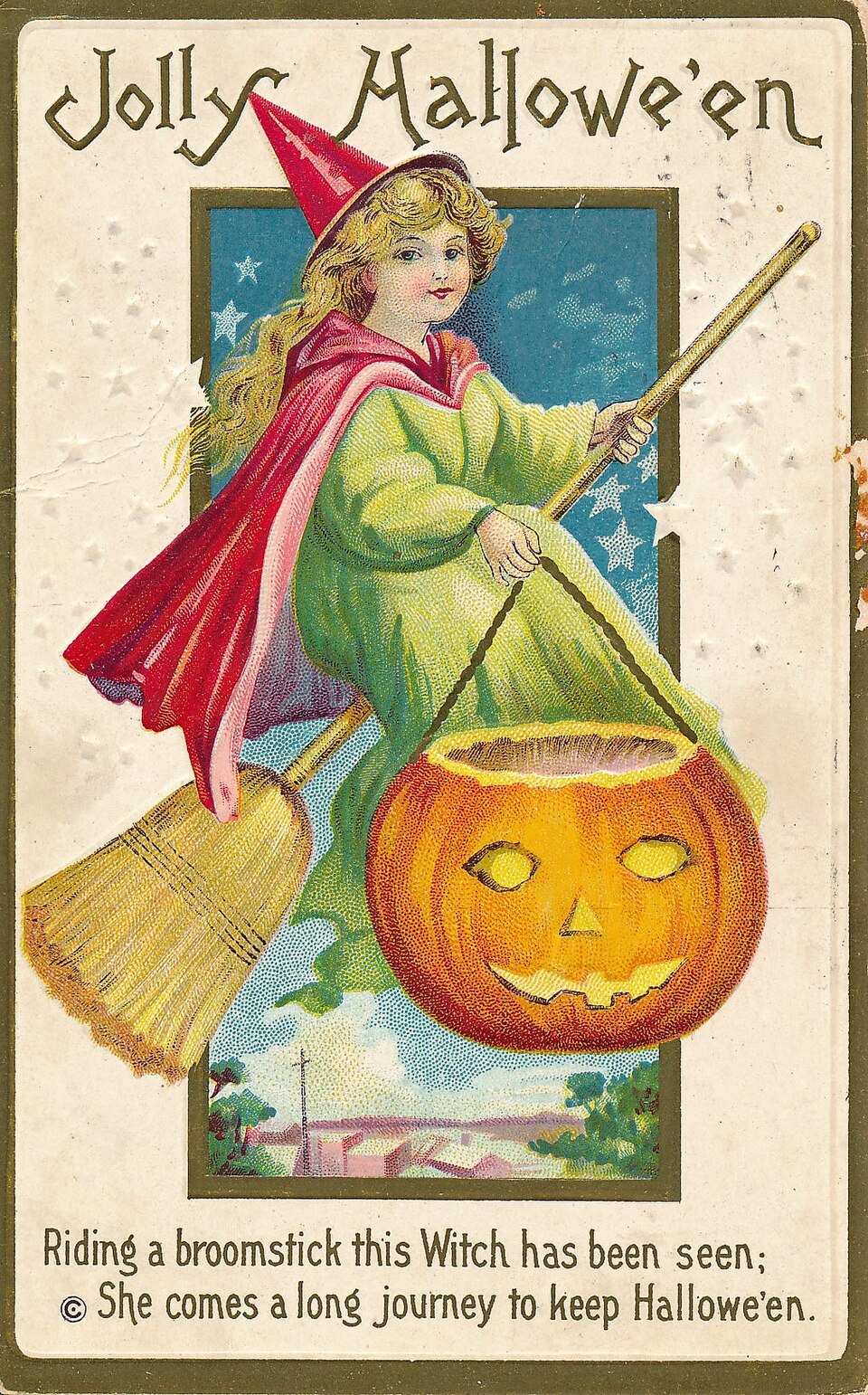
An American "Jolly Hallowe'en" postcard from 1915. Scan: Larry Syverson, CC BY-SA 2.0, via Wikimedia Commons
The more direct ancestor is guising, from Scotland and Ireland. On Halloween night children (and not only children) disguised themselves and went from house to house, and at each door they had to do something for their reward: a song, a poem, a joke, a bit of a dance. The disguises are usually connected to the old Celtic festival of Samhain on 31 October, when the boundary with the dead was thought to be thin, though I would be careful with that link. The evidence for what people actually did at Samhain two thousand years ago is thin as well, and a lot of what gets written about it was dreamed up by Victorian antiquarians.
What is clear is that Scottish and Irish emigrants took guising with them to North America. A newspaper in Kingston, Ontario, reported children out guising around the neighbourhood in 1911. Over the next fifteen years the custom spread across Canada and into the northern United States, and newspapers started reaching for a phrase. In 1922 the Edmonton Bulletin quoted "Treat up or tricks" as a Halloween slogan. By 1927 Alberta papers were describing children at back doors and front doors demanding "trick or treat," and the shorter version stuck.
A protection racket with costumes
That threat was real. By the early twentieth century, Halloween in many American towns had become a night of serious vandalism in many towns. Boys tipped over outhouses and soaped windows, took gates off their hinges, and on bad nights set fires. During the Depression it got worse, and local councils and police chiefs, with a good deal of help from parent groups, started looking for a way to buy the night back.
The answer they arrived at was, more or less, to pay the boys off. Organised parties and house to house visits gave children something to do besides vandalism, and householders kept a bowl of sweets by the door as insurance. When the phrase first shows up in an American paper, the Morning Oregonian in 1932, it comes with a list of what happened to people who didn't pay up: soaped windows, stolen doormats, uprooted shrubs and garbage cans dragged onto porches. In 1938 the Los Angeles Times described "Trick or treat!" as a Halloween hijacking game, which is a fair description of what it was.
Des Moines, Iowa, went another way in 1938 and moved the door knocking to 30 October, calling it Beggars' Night, to keep it apart from the mischief. Children there were expected to tell a joke or a riddle before they got any candy, which made Des Moines, without anyone intending it, one of the most Scottish places in America. Bad weather pushed the event onto Halloween itself in 2024, and in 2025 the city council made the move permanent, which ended Beggars' Night after more than eighty years.
Sugar rationing, then Charlie Brown
Sugar was rationed in the United States from 1942, and Halloween candy went with it. After the war the custom came back and went national in a few years, pushed along by the things children read and watched. Children's magazines ran trick-or-treat stories and party ideas in the late 1940s. The Peanuts gang went trick-or-treating in Charles Schulz's strip in 1951, and in 1952 Disney released a Donald Duck cartoon called Trick or Treat, in which Huey, Dewey and Louie get even with their uncle with the help of a witch.
It also picked up a charitable side. In 1950 a Philadelphia family's children carried collection boxes along with their candy bags and raised $17 for UNICEF. Trick-or-Treat for UNICEF grew from there into a school fixture in the 1960s and 70s, and plenty of American adults can still picture the little orange collection box.
The fears came along a bit later. Stories of razor blades in apples and poisoned sweets from strangers became a fixture of the 1970s and 80s. The sociologist Joel Best, who has spent decades tracking such reports, has never found a confirmed case of a child killed by candy handed out at random by a stranger. Parents still check the bag, and I don't blame them.
Back where it started
The National Retail Federation expects Americans to spend about $13.5 billion on Halloween this year, $4.1 billion of it on candy and slightly more on costumes. Since the 1980s American-style trick-or-treating has made its way back across the Atlantic, to the mild annoyance of some people in Scotland, who like to point out that their children are supposed to earn the sweets.
In parts of Scotland they still do. A guiser who turns up and just holds out a bag may well be asked what they've got to offer first, and a joke usually does it. I think that's the better version of the custom, and also the older one by a few hundred years.
Enjoyed this story?Get a new one every day on social.