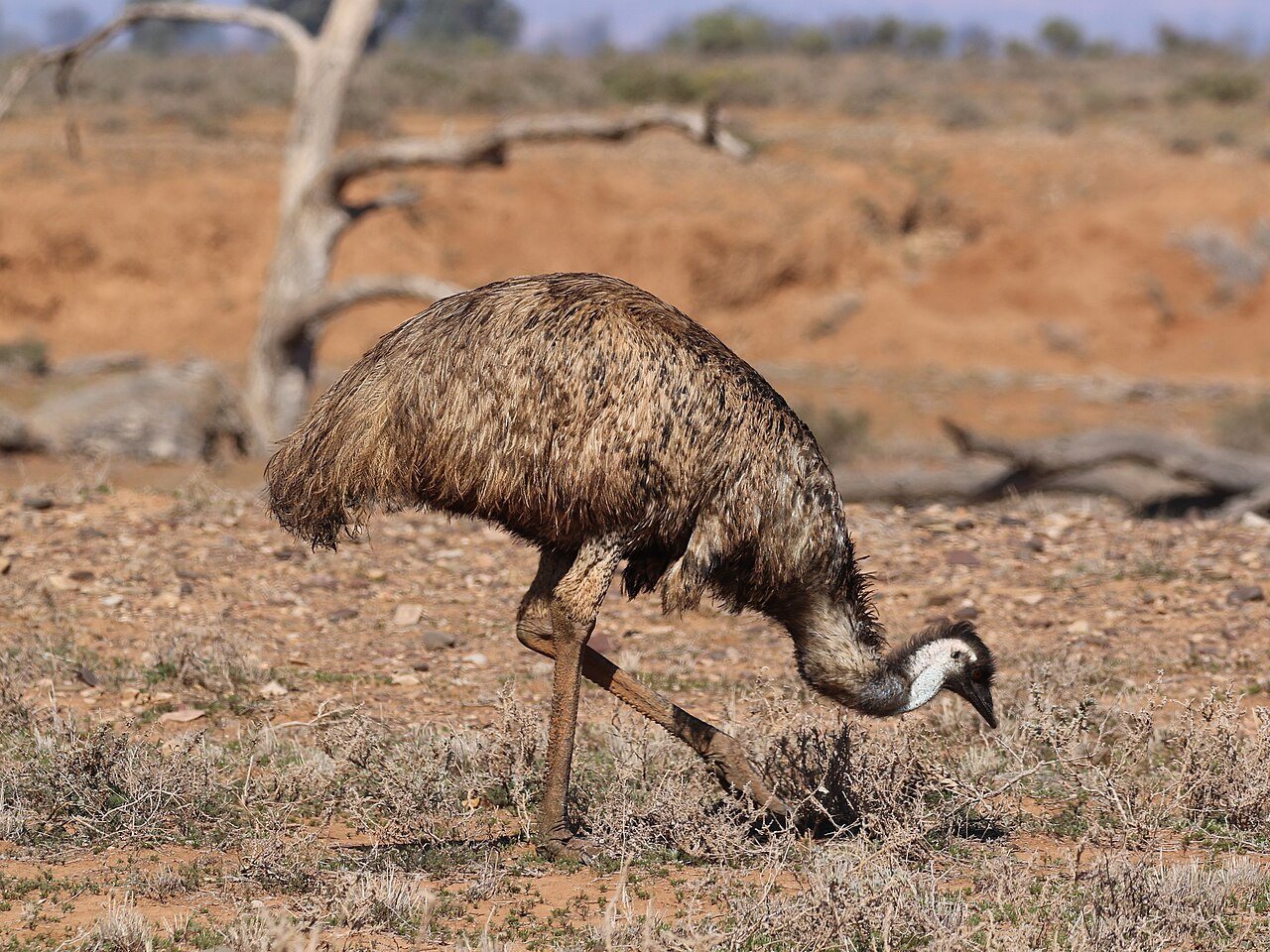
Photo: Donald Hobern, CC BY 2.0, via Wikimedia Commons
"If we had a military division with the bullet-carrying capacity of these birds it would face any army in the world," Major G. P. W. Meredith of the Royal Australian Artillery told a reporter, years after the event. "They can face machine guns with the invulnerability of tanks."
Meredith was the man who had commanded the Australian army's only campaign against a bird. It took place in the Western Australian wheatbelt in November and December 1932, involved two Lewis machine guns, ten thousand rounds of ammunition, three soldiers and roughly twenty thousand emus, and it has been the country's favourite joke about itself for ninety years. The documents, which I have spent more time with than I expected to, are funnier than the joke.
Soldiers on the land
The wheat country east of Perth had been settled after the First World War by returned servicemen on government schemes, and by 1932 the schemes had gone sour. The Depression had pushed wheat prices through the floor, a promised government subsidy had not arrived, and the farmers around Campion and Walgoolan, some 170 miles from the coast, were being told to grow more wheat to earn less money. Then the emus came.
Emus breed inland and walk toward the coast after the season, and that year perhaps twenty thousand of them found the cleared, watered wheat farms directly in their path. An adult emu stands about six feet tall, weighs up to a hundred pounds and can run at thirty miles an hour. They flattened crops, drank the stock water and, worse, knocked holes in the rabbit-proof fences so that the rabbits came in behind them. The farmers, many of whom had used machine guns in France, knew exactly what they wanted.
A minister agrees
A deputation went to Sir George Pearce, the federal Minister of Defence, who happened to be a Western Australian senator. Pearce agreed to send guns and gunners on condition that the farmers paid for transport, fed and housed the men, and covered the ammunition, and that a cinematographer from Fox Movietone came along. The ministry seems to have thought of it as useful target practice and useful publicity. One of Pearce's Senate colleagues promptly dubbed him Minister for the Emu War, and the name stuck to him for the rest of his career.
Meredith set out with Sergeant S. McMurray, Gunner J. O'Halloran, the two Lewis guns and the ten thousand rounds. Rain delayed them and scattered the birds. The campaign proper began on 2 November 1932.
Guerrilla tactics
The first engagement set the pattern. A flock of about fifty emus was spotted near Campion; the farmers tried to herd them toward the guns; the birds split into small groups and ran out of range before the gunners had fired more than a few bursts. Perhaps a dozen were killed. Two days later Meredith set an ambush at a dam where a thousand or so emus had been seen gathering. The gun jammed after twelve birds, and the rest were gone before it was cleared.
Meredith moved south, where the farmers said the birds were tamer. They were not. By the sixth day the men had fired about 2,500 rounds, and the number of dead emus was somewhere between fifty and five hundred depending on who was counting. Meredith tried mounting a gun on a truck, which produced the single best scene of the war: the truck could not keep up with the birds, the ride was too rough to aim, and at some point the gunner stopped firing altogether. (One account has an emu's body jamming the steering and the truck going through a fence. I would love that to be documented and have not found it.)
The ornithologist Dominic Serventy, who wrote up the episode later with a straight face, said the emus had evidently adopted guerrilla tactics: each large flock had split into innumerable small units, and every group appeared to have its own leader, a tall black-plumed bird that kept watch while the others fed. He was describing ordinary emu behaviour, but you can see why the newspapers enjoyed it.
Questions in Parliament
On 8 November the campaign was discussed in the House of Representatives, where it was treated with the seriousness it deserved. A Labor member asked whether a medal was to be struck, and the answer from the floor was that if there were any medals they should go to the emus, who had won every round so far. Pearce withdrew the gunners the same day.
The farmers asked for them back within the week, and Pearce, who had the ammunition to use up, agreed. The second phase ran from 13 November to 10 December, and Meredith's final report claimed 986 birds killed with 9,860 rounds, which works out to exactly ten rounds per emu and is a figure I distrust for that reason. He added that about 2,500 more had probably died of their wounds. The emus did not file a report.
What Australia did instead
The farmers asked for the military again in 1934, 1943 and 1948 and were turned down every time. The government switched to a bounty, which worked rather better: in six months of 1934 the state paid out on more than 57,000 emu beaks. In the longer run the answer was fencing. Western Australia's State Barrier Fence, the descendant of the rabbit-proof fences the emus had been breaking in 1932, still runs for well over a thousand kilometres along the edge of the wheatbelt and is still maintained, with emus and wild dogs named as the main reason for it.
The emu itself is doing fine. It is listed as a species of least concern, it shares the national coat of arms with the kangaroo, and there are a good deal more of them than there are Australians in the wheatbelt. A film about the war with John Cleese attached was announced a few years ago; I have not seen it appear, which, given the subject, seems about right.
Enjoyed this story?Get a new one every day on social.