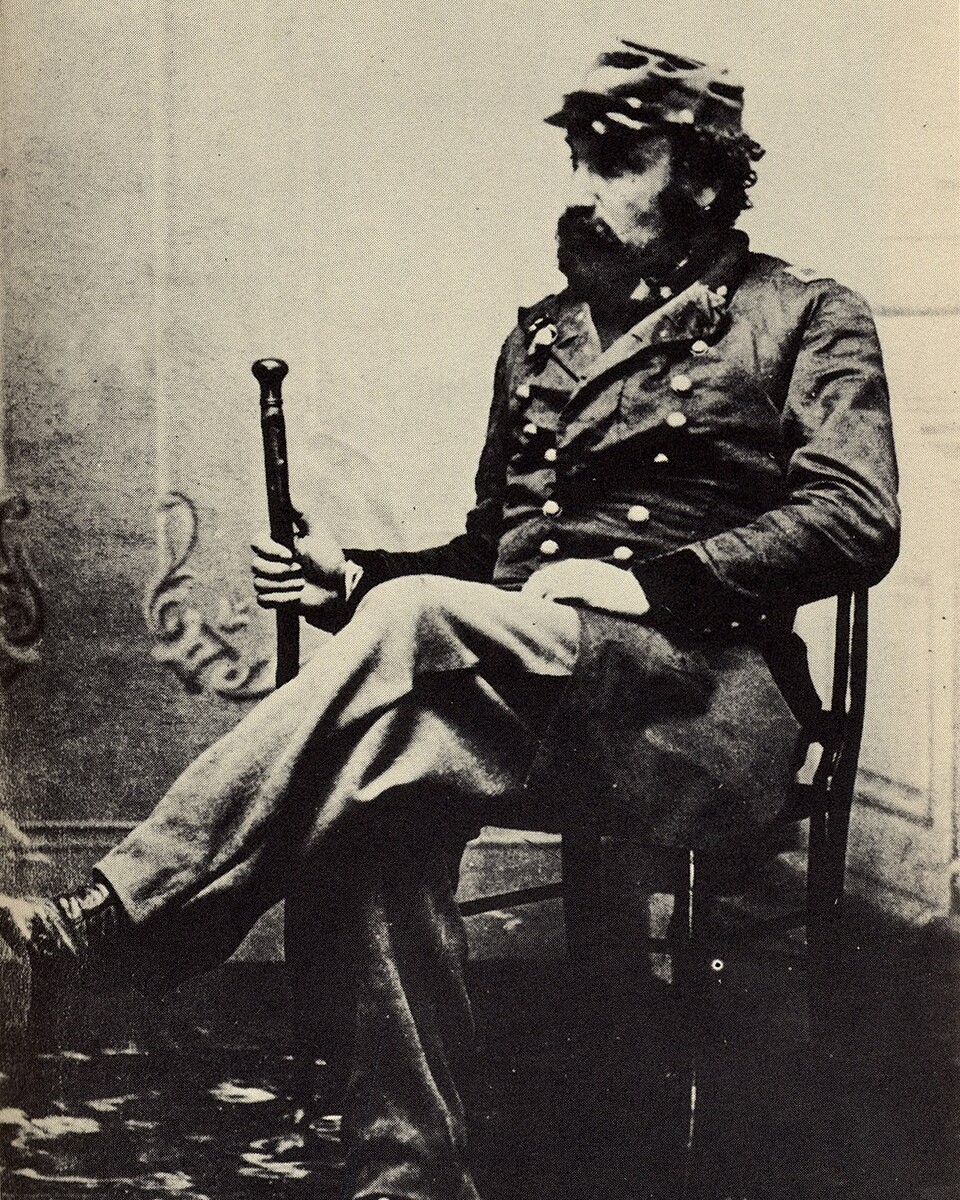
Photo: Unknown photographer, before 1880, public domain, via Wikimedia Commons
On 17 September 1859 the editor of the San Francisco Daily Evening Bulletin received a letter and, apparently for the amusement of his readers, printed it. "At the peremptory request and desire of a large majority of the citizens of these United States," it began, "I, Joshua Norton, formerly of Algoa Bay, Cape of Good Hope, and now for the last 9 years and 10 months past of S. F., Cal., declare and proclaim myself Emperor of these U.S."
Norton was about forty, recently bankrupt, and living in a cheap boarding house. He reigned until he died in 1880, and in that time he abolished Congress, dissolved both major political parties, ordered a bridge built across San Francisco Bay and issued his own money.
Plenty of cities have had a man in the street who believed he was royalty. What sets Norton apart is how much of San Francisco decided to play along with him, and kept it up for more than twenty years.
The rice that ruined him
Norton was born in England around 1818 and grew up in South Africa, where his father was a merchant. He arrived in San Francisco in late 1849 with an inheritance, by most accounts about $40,000, and did well in the gold rush economy, trading goods and buying property. Within a few years he was counted among the city's richer businessmen.
In late 1852 he tried to corner the city's rice market. A famine in China had cut off supply and the price had shot up, so Norton bought the entire cargo of a ship from Peru, roughly 200,000 pounds of rice, at what looked like a bargain. Then more ships full of rice sailed in through the Golden Gate and the price collapsed. Norton tried to get out of the contract and went to court, and the case dragged through the California courts for years before he lost. By 1858 he had filed for bankruptcy. A year later he was an emperor.
A court of one
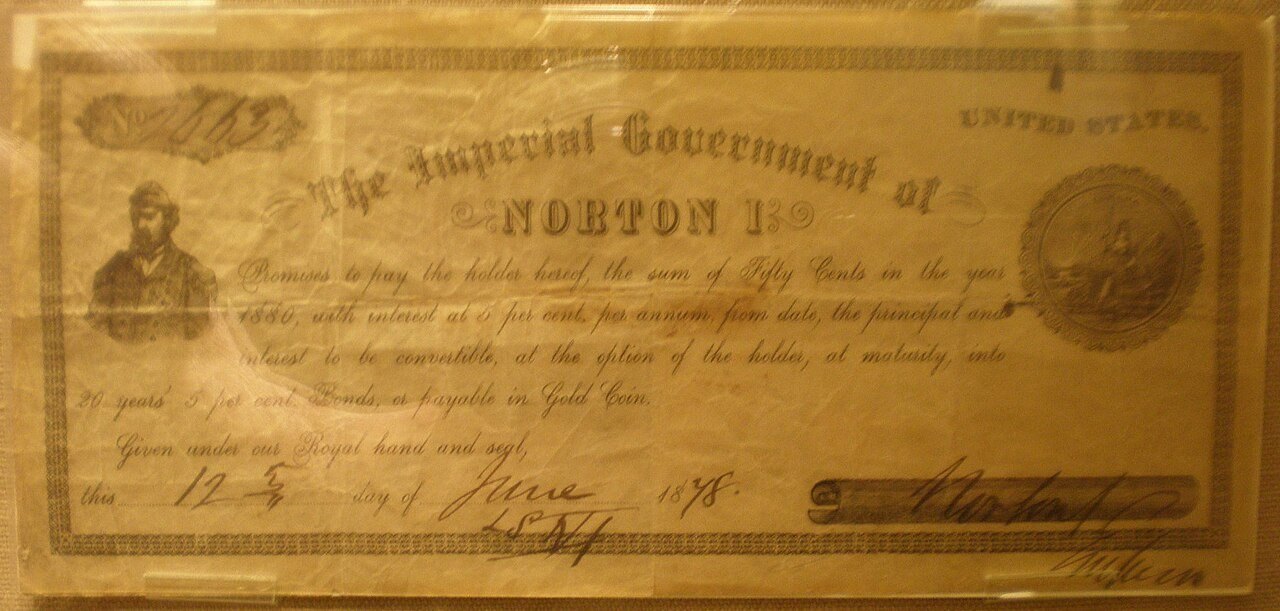
A fifty cent note issued in the name of Norton I in 1878, displayed at the Wells Fargo History Museum, San Francisco. Photo: BrokenSphere, CC BY-SA 3.0, via Wikimedia Commons
Rather than hide away, Norton went out to be seen. He walked the city every day in a blue military style uniform with gold epaulettes (soldiers at the Presidio are said to have given him the first one), a beaver hat with a feather in it, and a cane or sword depending on who was telling the story. He inspected the state of the pavements, checked that the streetcars were running to time, sat in on public lectures, and by several accounts made a point of attending different churches in turn, so as not to play favourites.
He lived in a rented room on Commercial Street at about fifty cents a day. For everything else he had his own currency. Norton had a local printer run off notes in his name, in amounts from fifty cents to ten dollars, and a fair number of bars and restaurants accepted them. Surviving notes now sell at auction for a great deal more than face value, which, on a long enough view, makes Norton a better currency manager than several governments of his era.
In 1870 the federal census taker came round to his lodgings and wrote down his occupation as "Emperor."
The decrees
Most of his proclamations were printed in the city papers, and some were written by the papers themselves, which complicates things for anyone trying to compile a reliable list. The genuine ones are not as mad as the title suggests. He ordered Congress dissolved in 1859 for corruption and told the army to clear the Capitol (it didn't). In 1869 he abolished the Democratic and Republican parties. In 1872 he ordered a bridge built from Oakland to Yerba Buena Island and on to San Francisco, and when nothing happened, he issued a sterner decree ordering a survey.
A decree fining anyone who called the city "Frisco" twenty-five dollars is probably one of the newspaper inventions. It has a great deal of support in San Francisco to this day anyway.
The arrest
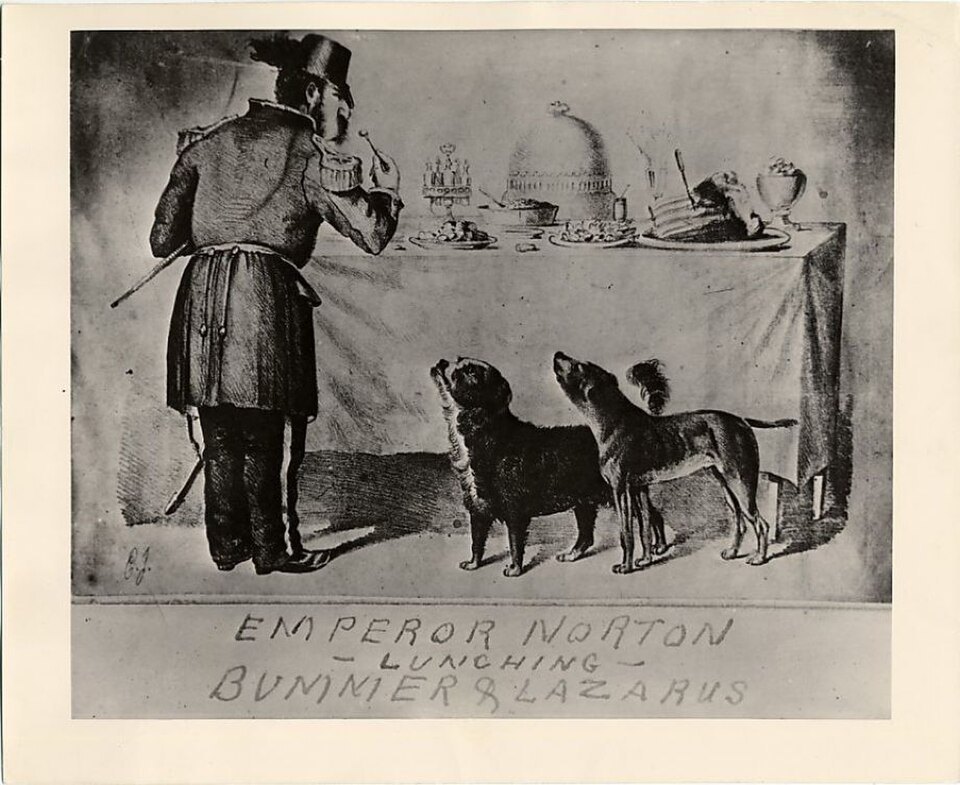
"Emperor Norton lunching, Bummer and Lazarus", a cartoon by Edward Jump. Public domain, via Wikimedia Commons
In 1867 a young police officer named Armand Barbier arrested Norton on the street with the idea of having him committed as insane. The newspapers were furious, and so, by most accounts, was the public. The police chief, Patrick Crowley, had him released and apologised. One remark from the affair has followed Norton ever since, that he had shed no blood, robbed no one and despoiled no country, "which is more than can be said of his fellows in that line." After that, the story goes, policemen saluted him in the street. Norton is said to have granted Barbier an imperial pardon, which seems about right for him.
There is plenty of legend mixed into all this. The two street dogs, Bummer and Lazarus, who are supposed to have followed him everywhere, were famous city dogs in their own right, but how much time they actually spent at the Emperor's heels is doubtful. Cartoonists liked to draw the three of them together, and the image stuck.
Thirty thousand at the funeral
On the evening of 8 January 1880, Norton collapsed on California Street, near Old St Mary's Church, and died before the carriage sent to take him to hospital arrived. The San Francisco Chronicle ran the news under the headline "Le Roi Est Mort." He had a few dollars in his pockets. His room, according to the reports of the day, held walking sticks, a sabre, a collection of hats and a bundle of letters and telegrams that pranksters had sent him over the years in the names of foreign heads of state.
The funeral was paid for by businessmen of the Pacific Club after the coroner's office would have given him a pauper's burial. Estimates of the crowd that filed past the coffin run as high as 30,000, which would have been something like one in eight of the people living in the city. I suspect that number grew in the retelling, as most numbers about Norton did, but every account agrees the crowd was enormous.
The bridge he asked for
In 1934, when San Francisco was clearing out its old cemeteries, his remains were moved to Woodlawn in Colma, south of the city, where his headstone reads "Norton I, Emperor of the United States and Protector of Mexico." The Bay Bridge opened in 1936, more or less along the route he had decreed 64 years earlier.
His admirers, and there are a lot of them, have spent decades trying to get the bridge named after him. In 2013 the California legislature instead named the western span after Willie Brown, the former mayor and Assembly speaker. The Emperor Norton Trust, a San Francisco group set up to keep his memory going, is still campaigning. Given that the bridge itself took 64 years to follow his decree, his admirers can probably afford to be patient about the name.
Enjoyed this story?Get a new one every day on social.